A free license key generator for any software creates a unique activation code that unlocks a program, plugin, or digital product without a fixed cost. These tools exist in two main forms:
- Web-based generators you use in a browser
- Offline scripts you run on your own machine.
Both produce a code string, but they differ in where that code gets created and who can see it happen.
This blog covers both methods, the legal line you need to know before you generate a single key, and a working comparison of license key generator tools people prefer in 2026.
What Is a License Key Generator For Any Software?
A license key generator is a program that creates a unique code string, then pairs that string with a validation method. Eventually, software can confirm whether the code is authentic or not.
A free software license key generator does two jobs at once: it produces a string that looks random and embeds a pattern inside it that the software can check later.
Here’s the software license key generation mechanism in three steps.
- Generation. An algorithm builds a string, usually alphanumeric, often in blocks separated by dashes (XXXX-XXXX-XXXX-XXXX). The algorithm can be as simple as a random string generator or as complex as a cryptographic signing function.
- Embedding. A checksum, hash, or digital signature gets built into the key. This is what separates a real key from a guess. Software checks this embedded pattern, not just the string’s format.
- Validation. When a user enters the key, the software runs it through the same algorithm (or checks it against a database, for server-based licensing) to confirm it’s legitimate before unlocking access.
Most free license key generator tools online only handle step one. They produce a string that looks like a license key but skips steps two and three entirely. That’s why a generated key from a generic online tool won’t activate real commercial software.
This distinction matters because three terms get used interchangeably in search, on forums, and in casual conversation, but they mean different things.
| Term | What it actually is |
|---|---|
| License key generator | Creates a code tied to a specific software’s validation logic (built by the software vendor or a licensing platform) |
| Keygen/crack | A tool built to reverse-engineer a paid software’s validation algorithm and bypass payment, usually illegal |
| Serial number | An older, simpler term for the same concept as a license key, most common in desktop software from the 1990s–2000s |
🡪 If you’re generating a key for software you own or have permission to license, you’re in generator territory.
🡪 If you’re trying to unlock someone else’s paid software without paying, you’ve crossed into keygen territory, and that’s where the next section matters.
Is It Legal to Generate a License Key for Any Software?
Generating a license key is legal when
- you own the software,
- have explicit permission from the rights holder, or
- are using a licensing system built for that exact purpose.
It becomes illegal the moment you use a generator to bypass payment or protection on software you don’t have rights to.
Roughly 37% of software installed on personal computers worldwide is unlicensed, a figure BSA’s Global Software Survey has tracked for years. Revenera’s own compliance data confirms the pattern holds across nearly every country surveyed.
In its 2026 Monetization Monitor, 31% of software producers named piracy their single biggest cause of revenue leakage, ahead of both overuse and misuse combined.
Those numbers explain why so many free key generator searches lead to warnings instead of working tools.
If you’re a software developer or seller, the safer version of this same idea is generating your own valid keys through a licensing system you control. That’s covered further down, with a direct path for anyone selling software through WooCommerce.
Free License Key Generator for Any Software [Online Method]
An online free license key generator for any software runs in your browser, produces a formatted code instantly. No download or install.
It’s the fastest route to a key, but it also means the string gets created on someone else’s server, which matters for the privacy section.
Here’s how the process works, step by step.
- Pick a format that matches your target software. Most license key generator tools let you set the character count per block and the number of blocks (4×4, 5×5, and so on). Check what format the software you’re licensing actually expects before generating anything.
- Set the character set. Decide between letters only, numbers only, or a mix. Skip ambiguous characters like O, 0, I, and 1 if the tool offers that option. This isn’t a cosmetic choice. A support ticket about a key that “doesn’t work” is often just a customer who typed a capital O instead of a zero.
- Generate the key. The tool outputs a string instantly, usually with a copy button.
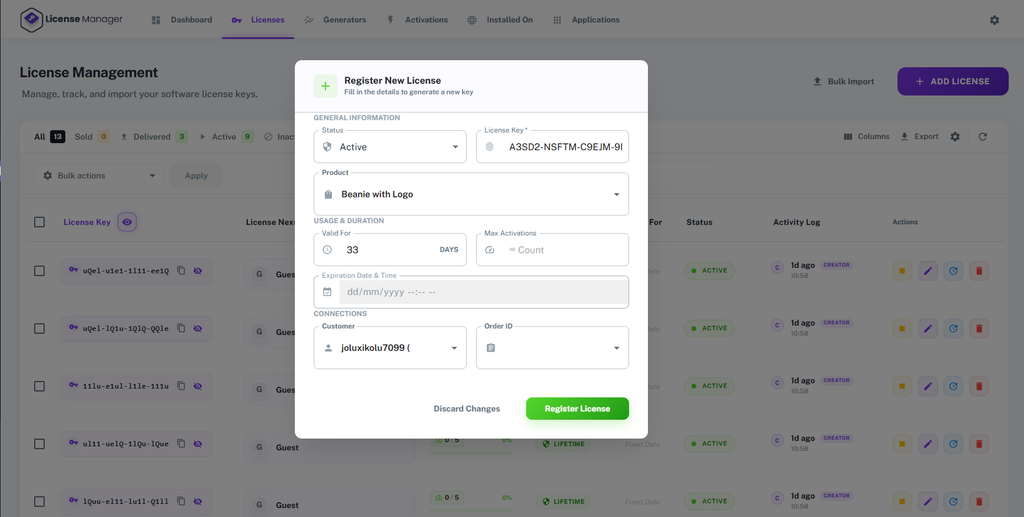
- Validate before you rely on it. A generated string that looks correct isn’t automatically a working key. If the software you’re licensing has its own validation system, run the generated key through that system to confirm it actually activates.
A well-formed key follows a structure the issuing software can check.
| Format type | Example | Common use |
|---|---|---|
| Dash-separated alphanumeric | XXXX-XXXX-XXXX-XXXX | Desktop software, plugins, WooCommerce products |
| GUID / UUID | 550e8400-e29b-41d4-a716-446655440000 | SaaS platforms, API-based licensing |
| Base32 (no ambiguous characters) | ABCD-EFGH-JKLM-NPQR | Systems built for manual, error-free entry |
| Prefixed key | RMA7-XXXX-XXXX-XXXX | Software that separates product line from the key itself |
Free License Key Generator for Any Software [Offline Method]
A free license key generator for any software that runs offline generates the key entirely on your own machine. No data sent to an external server at any point. This matters most for anyone generating keys for sensitive, internal, or enterprise software.
The core difference from the online method isn’t the output. Both produce a formatted string. The difference is where the generation logic runs.
Why some people specifically want offline license key generation:
- No product name, license type, or usage pattern gets transmitted anywhere
- No dependency on a third-party service staying online or staying free
- Works in air-gapped environments where internet access isn’t available or isn’t allowed
- Full control over the generation algorithm, since you’re running the script yourself
Common offline methods:
- Self-hosted open-source scripts. Command-line tools like LicGen generate license keys and license files locally, with no network call involved. These suit developers who want a scriptable, repeatable process they can fold into a build pipeline.
- Self-hosted licensing platforms. Tools like LicenseGate can be deployed on your own infrastructure rather than used as a hosted service, giving you the convenience of a full licensing system without sending data off-site.
- Custom scripts. A short script using a language’s built-in cryptographic library (Python’s secrets module, for example) can generate a properly formatted key with a checksum in a few lines of code, with zero external dependencies.
Offline license key generation methods take longer to configure than pasting into a web form. They put the security responsibility on you rather than a hosted service.
For a one-off personal key, that tradeoff usually isn’t worth it. For a business licensing software at scale, it almost always is.
Best Free License Key Generator Tools Compared (2026)
The best free license key generator tools for 2026 split into three categories: fully hosted with a free tier, open-source and self-hostable, and simple no-signup web utilities.
Here’s how the main options stack up.
| Tool | Free tier | Deployment | Best for |
|---|---|---|---|
| Keygen | Dev tier: up to 100 active licensed users, 10 product releases | Hosted (cloud) | SaaS and API-first products that need real validation, not just generation |
| LicenseGate | Free Early Access cloud tier, plus self-hosted option | Hosted or self-hosted | Developers who want full control over licensing logic without paying upfront |
| LicGen | Free, open-source | Self-hosted (CLI) | Scriptable, offline generation folded into a build pipeline |
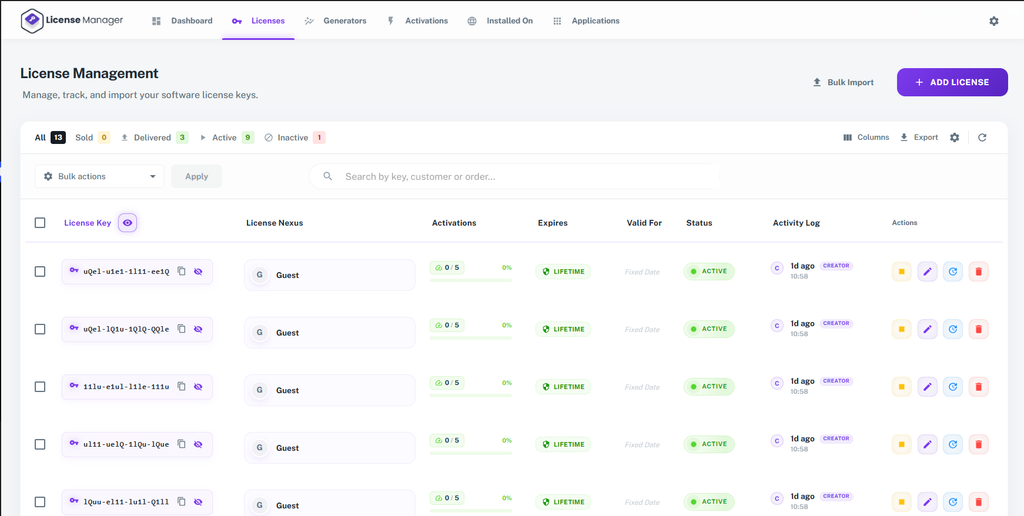
| License Manager for WooCommerce | Free version available on WordPress.org | Self-hosted (WordPress plugin) | Anyone selling software, plugins, or digital products through WooCommerce |
| Simple online generators (no-signup tools) | Fully free | Browser-based | Quick, one-off formatted strings with no validation system attached |
A generator and a licensing system aren’t the same thing, and this table splits along that exact line.
🡪 Keygen and LicenseGate generate keys and validate them against a live system, which means a key only works if it actually exists in their database.
🡪 LicGen and the simple online tools generate a correctly formatted string and stop there.
Here’s a simple way to decide which category fits your situation.
- Building a SaaS product? Go with an API-based system like Keygen or LicenseGate. You need real-time validation, not just a string generator.
- Selling plugins, themes, or digital products through WooCommerce? License Manager for WooCommerce handles generation, delivery, and revocation in one plugin, built specifically for that storefront.
- Running a one-off personal project or testing a format? A simple online generator or a short offline script covers it. You don’t need a hosted validation system for something that isn’t being sold.
- Need offline, air-gapped generation for internal or sensitive software? LicGen or a custom script keeps everything on your own machine, with the tradeoffs covered in the offline method section above.
Match the tool to whether you need validation, not just generation.
License Key Generator vs. Serial Key Generator vs. Product Key Generator: What’s the Difference?
A software license key generator, a serial key generator, and a product key generator all describe the same basic function using different terminology.
The mechanism underneath is nearly identical in all three cases.
| Term | Origin and common use |
|---|---|
| License key generator | The current standard term, most common in SaaS, plugin, and API-based licensing since the 2010s |
| Serial key generator | Older terminology, carried over from desktop and boxed software in the 1990s and 2000s, still used interchangeably today |
| Product key generator | Popularized by Microsoft’s product activation system, now used broadly for any single-string activation code |
| Activation key generator | Functionally identical to the above, emphasizes the unlocking action rather than the code itself |
When you’re searching for a license key generator, tool, or guide, these terms are interchangeable. If a tool calls itself a “serial key generator,” it does the same job as one labeled “license key generator,”. And the same guidance in this article applies to both.
How To Generate A License Key For Your Own Software (For Developers And Sellers)
Generating a license key for your own software means building or using a system that creates unique codes and checks them against your product.
The process has 4 parts.
- Pick your generation method. A self-hosted script, an API-based platform like Keygen or LicenseGate, or a plugin built for your storefront.
- Set your key rules. Length, character set, and whether each key ties to a specific product, version, or customer.
- Connect generation to delivery. The key needs to reach the buyer automatically. Manual delivery doesn’t scale past a handful of sales.
- Build in expiration and revocation. A license that never expires and can never be revoked isn’t a license. It’s a permanent unlock code with no recourse if something goes wrong.
If you sell through WooCommerce, this whole process collapses into one plugin.

Go to Plugins, then Add New, and install License Manager for WooCommerce.
Click Activate License to turn it on.

The plugin generates a key at the moment of purchase, ties it to that order, and lets you revoke it if the order gets refunded or cancelled.